
AS2 and APIs are complementary integration patterns, not interchangeable buzzwords. An API lets one application request or submit data to another application using an agreed interface. AS2 transports a business document between trading partners with specific B2B controls, including certificates and MDNs. Many successful architectures use both.
AS2 is partner-facing; APIs are application-facing
An API is ideal when your application needs an immediate response: create an order, retrieve inventory, update a shipment, or query account data. It exposes defined operations and data models. AS2 is ideal when a partner expects a document exchange: send an X12 850, receive an EDIFACT DESADV, and retain evidence that the receiving AS2 system handled the transmission.
The comparison is therefore less about which technology is modern and more about who controls the contract. If your trading partner mandates AS2, an API cannot replace it. If your own application needs a programmatic way to submit files to an AS2 gateway, an API can be the bridge.
Why large partners still mandate AS2
The decision is usually about scale rather than a preference for older technology. A retailer with several thousand suppliers needs one way to send an order and one way to receive an invoice. Publishing a supplier API would mean designing, versioning and supporting an interface for counterparties whose systems range from a modern ERP to a small local EDI provider, issuing credentials to all of them, and running a developer support desk for the long tail of questions.
AS2 moves that work onto a transport their suppliers’ software already speaks. The document semantics are standardized too, as EDIFACT or X12, so nobody has to agree a new data model per relationship. The protocol is specified in RFC 4130 and commonly implemented in EDI packages, which is the whole point: the partner is choosing a common denominator, not a favorite technology.
There is an evidence argument as well. A signed MDN is the same artifact from every supplier, which is what an audit of electronic document exchange wants to see. Where a large partner does publish an API, it usually covers a narrow service — order status, catalog updates, carrier tracking — alongside the AS2 flow rather than instead of it.
Compare the operating models
| Question | AS2 | API |
|---|---|---|
| Primary unit | File or business document | Resource, event, or operation |
| Typical confirmation | AS2 MDN | HTTP response, webhook, or status endpoint |
| Partner onboarding | Certificates and bilateral setup | Credentials, scopes, endpoint contract |
| Best for | EDI/B2B document exchange | Real-time application integration |
| Common failure pattern | Certificate or MDN mismatch | Authentication, schema, or rate-limit error |
What an HTTP 200 proves, and what an MDN proves
An HTTP 200 means the endpoint received your request and took responsibility for it. Unless the API documentation says otherwise, it does not mean the document validated, and it does not mean anything was posted in the partner’s system. Many APIs return 202 precisely to make that distinction visible.
An AS2 MDN is stronger in one specific respect. A signed MDN carries a Received-Content-MIC that lets you verify the partner holds the same bytes you sent, which is a statement they produced rather than a line in your own log. The AS2 protocol guide places that receipt in the message flow, and synchronous vs asynchronous MDN covers what it does and does not prove.
What the MDN does not tell you is whether the order was accepted. That answer belongs to the business layer — an EDIFACT CONTRL or APERAK, an X12 997, 999 or 824 — and it is missing from most API integrations too, unless someone designed it in. The difference to keep in mind is whose record you are holding: an API call leaves your log of your own request, while a signed MDN leaves the partner’s statement about what arrived.
Use APIs around AS2, not instead of it
An API-backed AS2 gateway gives developers a clean integration surface. Your ERP, middleware, or application can submit an outbound document through an API; the gateway applies the correct partner profile, signs and encrypts the message, and sends it over AS2. On inbound delivery, a webhook or API event can trigger validation and ERP processing.
This pattern keeps AS2-specific configuration out of the business application. Developers work with a stable internal interface while B2B specialists manage AS2 IDs, certificates, MDNs, and partner endpoints. The ERP integration guide shows how to divide these responsibilities.
Put a REST API on your side of the AS2 endpoint
The split that works in practice keeps AS2 at the edge and plain HTTP inside your own network. Your application submits a document to an endpoint, naming the sending station and the receiving partner; the station signs it, encrypts it, delivers it and records the MDN. Inbound documents either wait in an inbox your systems poll, fetch and acknowledge, or are pushed to a webhook of yours with a bearer key and headers identifying the partner and the station.
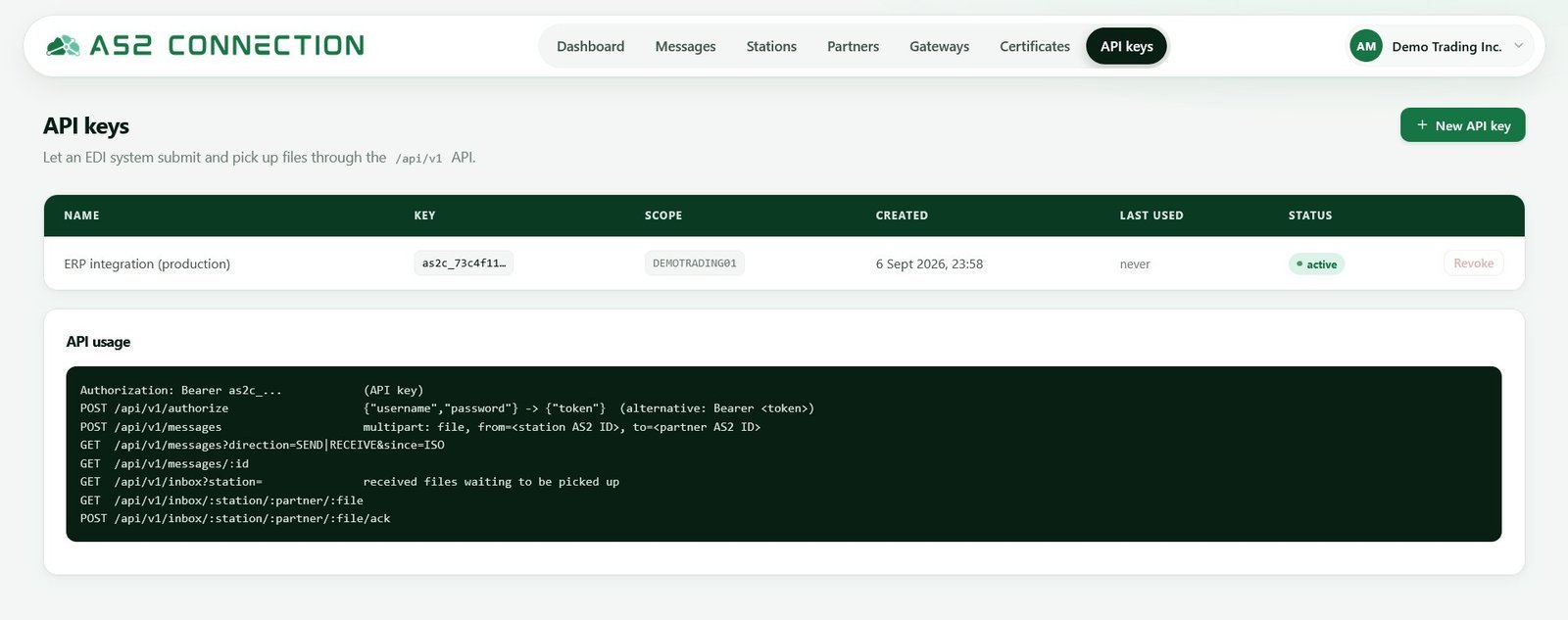
Two things follow from that split. Developers never touch certificates, MIC algorithms or partner endpoints, so a new partner is a configuration entry rather than a release. And the transport evidence stays in one place, independent of whichever application happens to be consuming the file. The pull and push patterns have different failure modes, compared in automating EDI document exchange.
Duplicate control: Message-ID versus idempotency keys
AS2 catches a repeated transmission at the gateway using Message-ID; an API catches a repeated call using an idempotency key you supply. Neither one stops you processing the same business document twice, because a partner resending an order after a failed batch normally sends it as a new message with a new identifier. Deduplicate on the business key as well — document type, partner and document number — and store the transport identifier next to the document so support can join the two views later.
AS2 vs API: the questions that decide the interface
The AS2 vs API choice is rarely free, since the partner has usually made it already. When both are genuinely open, these are the dimensions that change the design rather than the vocabulary.
| Question | AS2 | API |
|---|---|---|
| Who defines the contract? | The partner’s implementation guide, agreed bilaterally | The API owner, unilaterally, in their documentation |
| How is the counterparty identified? | An AS2 identifier plus a certificate the receiver imported | A credential they issued: token, API key or client certificate |
| What evidence survives? | A signed MDN with a MIC, plus the archived message | Your own request logs, unless the partner returns more |
| How are duplicates caught? | Message-ID at the receiving gateway | An idempotency key, where the API supports one |
| Who retries? | The sending gateway, on a configured schedule | Your client, within their rate limits and error semantics |
| What does a change cost? | A partner change window and a retest of the flow | A version bump you follow on their timetable |
| Where do failures appear? | A message state and a negative MDN naming a reason | An HTTP status and an error body, if you logged it |
Choose based on the transaction journey
Choose AS2 when the partner’s implementation guide requires AS2, a signed receipt is important, or the exchange is document-oriented. Choose an API when the receiver offers a supported API and your process benefits from real-time operations. Use both when an API is your internal automation channel and AS2 is the external delivery channel.
Do not equate a successful API response with AS2 delivery. In an integrated workflow, measure each state: API acceptance, AS2 transmission, MDN receipt, EDI validation, and downstream business posting. AS2 transaction monitoring explains how to make those states visible.
When a partner API is the better choice
Use the API when the exchange is a question rather than a document:
- You need an answer now — stock availability, a price check, a delivery slot, carrier tracking — and a batch document would arrive too late.
- The counterparty is small, imposes no EDI requirement, and already publishes a documented interface.
- The traffic is many small state updates rather than a few complete documents, so batching is the wrong shape.
- Both ends are systems you control, where a shared contract costs nothing to change.
The test is whether you need a business document that has to stand up later or an answer with low latency. Orders, despatch advices and invoices are the first; lookups are the second.
Frequently asked questions
Can an API replace AS2 with my trading partner?
Only if the partner offers one for that flow and agrees to it in writing. The AS2 requirement usually sits in the trading agreement and in their onboarding process, and their gateway has no route for your traffic over anything else. Ask, since some partners run both, but plan on the answer being AS2.
Is AS2 outdated compared with REST APIs?
No, and framing it as old against new misses what each of them does. AS2 provides per-message encryption, a signature tied to an identity the receiver imported, and a receipt with evidential value, uniformly across thousands of partners. REST provides a low-latency request-response interface. Nothing in REST replaces the receipt, and nothing in AS2 replaces a lookup.
Does a 200 response from my AS2 platform mean the partner received the file?
No. It means your submission was accepted for delivery. Receipt by the partner is a separate event, reported by the MDN that comes back either in the response to the AS2 transmission or later as its own POST. Treat a message as delivered only once the MDN has arrived and its MIC matches.
Do I need a separate AS2 station for each trading partner?
No. One station carries your AS2 identifier and your certificate, and every partner you exchange with is configured against it, each with their own endpoint, certificate, algorithms and MDN policy. Separate stations are worth having when you need separate identities — different legal entities or divisions with their own GLNs — not simply because you added another partner.
For a partner-facing transport service with developer-friendly integration options, explore AS2Connection. Begin with the AS2 connection setup guide when the partner has already issued its specifications.

Leave a Reply