
An AS2 server is the software and infrastructure that sends, receives, secures, and tracks AS2 messages for an organization. It is the partner-facing component behind an AS2 connection: it receives documents at an AS2 URL, validates signatures, decrypts payloads, generates MDNs, and keeps the evidence required to operate the exchange.
An AS2 server is not an EDI translator or an ERP. It transports the document. Your EDI or application layer interprets the purchase order, invoice, claim, or shipment file after delivery.
What an AS2 server is responsible for
At minimum, a production AS2 server needs to manage partner profiles, certificates and keys, inbound and outbound endpoints, message queues, retries, MDNs, logs, and operational alerts. It should also allow a team to find one message quickly by partner, time, document identifier, or transmission state.
Each of those responsibilities has a lifecycle. Certificates expire. Partners change endpoints. A message can be transmitted but not receive its expected receipt. Monitoring and incident ownership are therefore as important as the protocol implementation. For the security mechanics, read Is AS2 secure?.
The parts of an AS2 server, component by component
Every AS2 server implements the same short list of functions, whether it runs as a Java process on your own virtual machine or as a managed station somebody else operates. Knowing that list makes vendor feature pages easier to read.
| Component | What it does | What goes wrong when it is weak |
|---|---|---|
| HTTPS listener | Accepts partner POSTs at one stable URL and port | Timeouts, TLS handshake errors and 404s that never reach the AS2 layer |
| Certificate and key store | Holds your private key and every partner’s public certificate | An expired certificate stops traffic on a fixed date; a leaked private key destroys your evidence |
| Partner profile store | Per-partner identifiers, receiving URL, algorithms and MDN mode | One case difference or trailing space in an identifier rejects otherwise valid messages |
| S/MIME engine | Signs and encrypts what you send, decrypts and verifies what arrives | Negative MDNs reporting decryption-failed or authentication-failed |
| MDN generation and validation | Issues receipts inbound, checks the MIC on receipts for your outbound messages | You transmit successfully and still cannot prove the partner received those bytes |
| Retry queue | Re-attempts delivery after transport failures, a bounded number of times | Silent drops when a partner is briefly down, or duplicate floods |
| Message archive | Keeps payload, headers, MDN and timestamps searchable for your retention period | “Did you receive our invoice on the 3rd?” gets an opinion instead of evidence |
| Delivery into your systems | Hands the decrypted payload to your ERP or EDI translator by API, webhook or folder | Documents arrive correctly and then sit in a gateway nobody reads |
The first four are the standardized part: message structure, headers such as AS2-From, AS2-To and Message-ID, and receipt behavior all come from RFC 4130, and the AS2 protocol guide walks through a full exchange. The last four are where implementations differ, because retention, search and delivery are not protocol features. Spend your evaluation time there rather than on the cipher list.
Self-managed, hosted, or cloud gateway?
A self-managed AS2 server can be appropriate when an organization has strict hosting constraints, a mature operations team, and a need to control every infrastructure component. It also creates obligations: patches, backups, key protection, high availability, monitoring, capacity, and support coverage.
A hosted AS2 server or cloud gateway shifts the server operation to a service while your team controls its partner connectivity and business workflow. This is often attractive for teams that need to go live with several partners without standing up an appliance or virtual machine. Review cloud AS2 gateway vs on-premise AS2 server before deciding.
What it actually costs to run your own AS2 server
The software is rarely the expensive part. OpenAS2 is free software, and installing it is not where the effort goes. The cost is everything that must sit around it before a partner treats the endpoint as production.
- A public address that does not change — many partners allow-list source IPs, so you need a static IP outbound and a stable hostname and port inbound. Anything behind a rotating NAT pool gets blocked without explanation.
- A TLS certificate and the DMZ around it — the listener is exposed to the internet by design, which means firewall rules in both directions and a renewal process for the transport certificate, separate from your AS2 certificate.
- Availability outside business hours — partners transmit overnight, at weekends and on your public holidays. An endpoint down at 03:00 does not queue politely on their side forever; their retry count runs out.
- Patching and backups — an internet-facing service needs its runtime kept current, and the keystore needs an encrypted backup with a restore you have tested. Losing the private key means re-exchanging certificates with every partner.
- Certificate lifecycle — a rotation has to be coordinated with every partner who imported the old certificate, and it is the usual reason a connection that worked for two years suddenly stops. AS2 certificate expiration covers how to stage one without an outage.
- Somebody watching it — a failed transmission with no owner is an unnoticed failed transmission. Alerting and an on-call rota are part of the running cost.
Price that list against your own rates before comparing it to a subscription. Self-hosting wins when you already carry the infrastructure and the marginal cost is near zero. It loses when AS2 would be the only reason your organization runs a hardened, always-on, internet-facing service.
A managed station moves that list to a provider while leaving you the parts that are genuinely yours: the AS2 identifier, the certificate, the partner relationships and the documents. Creating one is mostly a matter of declaring who you are on the network.
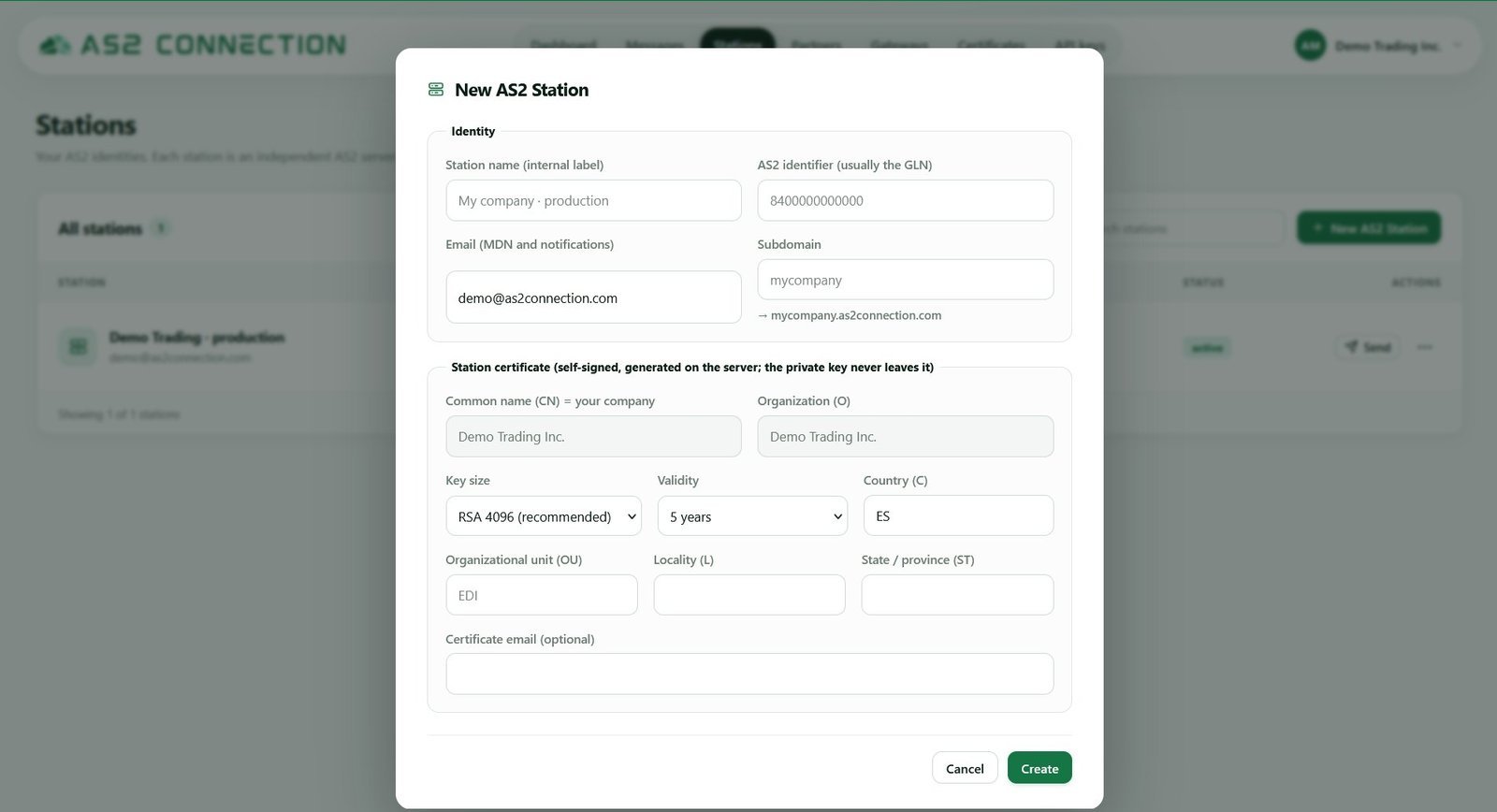
A subscription that includes retention, retries and support is not competing with the OpenAS2 download; it is competing with the download plus the six items above. Published AS2 pricing gives you a number to put in that column.
When you need one
You need an AS2 server—or a managed equivalent—when a trading partner asks you to send or receive files by AS2. Typical triggers include a retailer onboarding a supplier, a logistics provider exchanging status files, or an enterprise integrating EDI documents with a new partner. Obtain the partner’s implementation guide first, then use the onboarding checklist.
Signs you have outgrown a shared or partner-provided arrangement
Plenty of suppliers start without an AS2 server of their own: the partner hosts the connection, or a service provider transmits under their identifier and drops files into a portal. There is no reason to change that until one of these appears.
- A second partner asks for AS2 and you cannot reuse the first arrangement, because the identifier and certificate belong to somebody else.
- Somebody asks you to prove a document was delivered and the best you can produce is a portal screenshot, not the signed MDN and its
Received-Content-MIC. - Files are downloaded by hand. Any volume a person opens one at a time will eventually be opened late.
- You need documents inside your ERP rather than in an inbox, which makes it an integration problem rather than a transport one.
- Changing anything — a new document type, an extra ship-to location — means raising a ticket with whoever owns the endpoint and waiting.
The common thread is control of identity. Once your organization has its own AS2 identifier and certificate, each additional partner is a configuration change rather than a project.
Selecting an AS2 server solution
Evaluate a solution against the partner requirements and operating model, not only a feature checklist. Confirm that it supports the needed signing, encryption, MDN, certificate, retry, and integration options. Ask who will receive alerts, rotate certificates, trace messages, and assist during a partner test. A good choice makes those ownership boundaries visible.
Frequently asked questions
Do I need an AS2 server to receive files from a trading partner?
You need an AS2 endpoint the partner can reach, which is either your own AS2 server or a managed station operated for you. There is no client-only mode for inbound AS2: the partner initiates the connection and POSTs to a URL you publish, so something of yours has to be listening and able to return an MDN.
What is the difference between an AS2 server and an AS2 gateway?
In practice the terms overlap and most products answer to both. “Server” emphasizes software you install and operate; “gateway” emphasizes the boundary role, where partner traffic becomes files your applications can use. The function list matters more than the label, and the AS2 gateway explainer covers where the distinction carries weight.
Can I run an AS2 server without a static IP address?
Technically yes, since AS2 identifies parties by certificate and identifier rather than by address. In practice many partners allow-list the source IP of everyone who connects to them, so a changing outbound address gets your messages refused. That requirement alone often decides the hosting question.
Does an AS2 server have to be online outside business hours?
Yes, if you receive documents. Partners run transmission schedules at night and over weekends, and your endpoint has to accept the message and return an MDN when they do. A missed window is not silent: the partner sees delivery failures against you and raises it before your team notices.
Can I move to a different AS2 server without re-onboarding every partner?
Usually yes, provided the AS2 identifier and certificate are yours rather than your provider’s, in which case partners need only your new receiving URL and often a new source IP for their allow-list. Whether that holds for a given arrangement is one of the exit questions in cloud AS2 gateway vs on-premise, and it is worth an answer in writing before you sign.
AS2Connection offers the gateway layer as a SaaS service, helping businesses establish their own AS2 connections without taking on routine server administration. The next practical step is setting up an AS2 connection with a trading partner.

Leave a Reply